His post on 2:196 - quranology.wordpress.com/2012/04/20/ch-2-vs-196-the-completion-of-the-challenge/
Quote: "This follows from the process of 195, to spend in the way of Allah (due to the ‘wa’ which denotes simultaniety). We are to complete the challenge and fertilisation for Allah, which is to establish and grow His system in the world. Whoever is prevented should send forth progressions and not let go of this thought until it reaches its place of effectiveness. Those who are ill or with psychological issues should fast or give charity or keep up their life activities. Once they are secure, they are continue with fertilisation towards the challenge (that is to keep growing Gods system till it challenges oppression) by keep contributing hadya/progressions. If he is unable to make progress during the period of challenge (see 2/189, the period of challenge and the period for the people), he is to fast for ‘three’ periods during the challenge and a number of periods during the times for people. That would be make the formula for perfect social living (3asharah kaamilah). These are for the people whose ahl/kith and kin are not present in God’s sanctified system."
## End quote.
TLDR: summary: 17 potential problems listed for his translation of one single verse. He attempts to defend his translation in a methodology debate we had: HERE. He was eventually banned from free-minds.org forum due to repeated false statements and slander.
I posted the entry below on his blog Oct 27th 2012. It never got his approval to be made public on his blog:
Screenshot: 11th Jan 2026
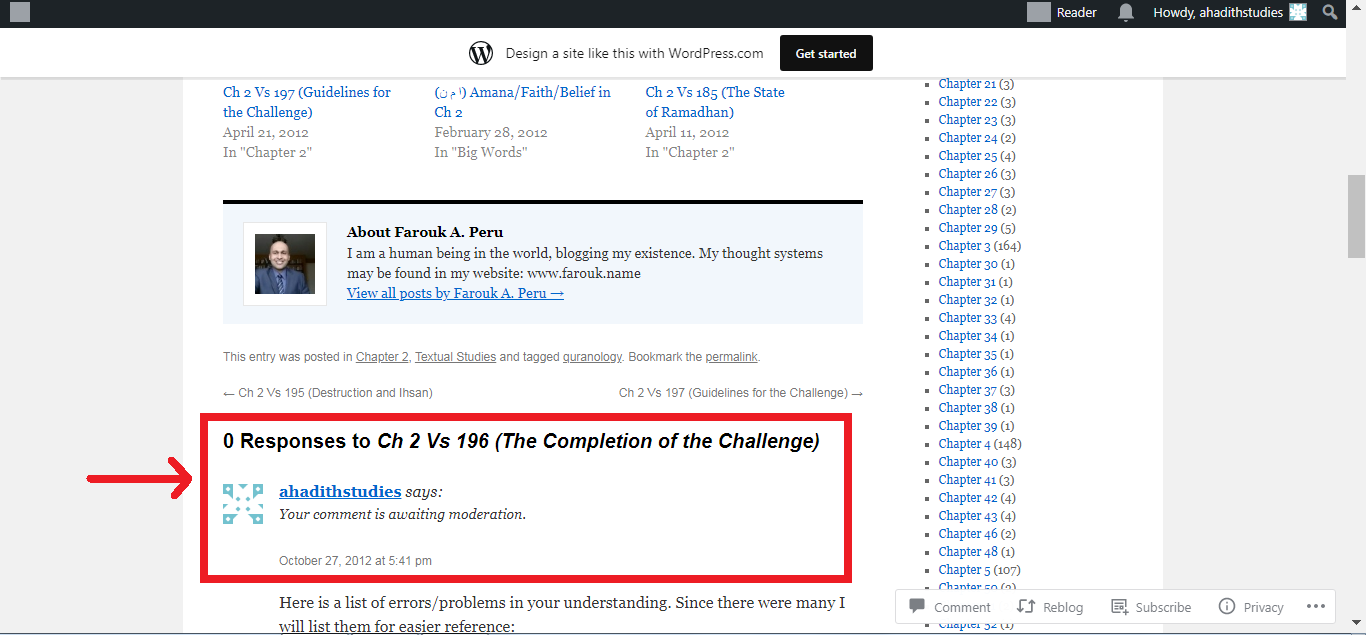
I will let readers decide what the above tells us.
## My entry:
Here is a list of errors/problems in your understanding. Since there were many I will list them for easier reference:
Abbreviations:
NQCR = no Quran cross-reference
NQE = no Quranic evidence
NCADR = no classical Arabic dictionary reference
1) You said – “We are to complete the challenge and fertilisation for Allah, which is to establish and grow His system in the world. Whoever is prevented should...”
Prevented from establishing and growing His system in the world? If so that would mean pretty much everyone in the world would be classed as “prevented”, because at best it would be a tiny tiny minority who could even claim to have ESTABLISHED and GROWN His system in the world.
Further, what establishing and growing means is anyone’s guess. It seems it would be subjective, and difficult to determine when this had been fulfilled, if ever.
2) You translate “al hadiy” as “progressions” with NQCR, NQE, NCADR.
Having an alternative translation for a word is fine but at least one would expect an explanation or some presentation of evidence for an unheard of word choice. Secondly, the word is actually “al hadiy” (definite noun, singular) so it should have been translated as “the progression”. The use of “al” commonly signifies that this noun and what it refers to is well known to the addressed audience. Of course, if you were to translate it in this way, it would be more awkward for you to explain.
3) Translates “raas” as “thought” with NQCR, NQE, NCADR.
Again, choosing an unusual word choice is fine if it can be backed up with some sort of reasoning/evidence, but you present none. Furthermore, it is plural, not singular.
4) Translates “mahilla” as “place of effectiveness” with NQCR, NQE, NCADR.
5) Do you expect a person with psychological issues to determine they are so and therefore fast, give charity etc? I’m very interested to know how this would be, do tell.
6) “Once they are secure” – secure from what?
7) Incorrectly imply the verse says “continue with the umra” when the Arabic actually uses a perfect verb, meaning an action done/completed, meaning “whoever benefitted/enjoyed with the umra”, thus there can be no “(that is to keep growing Gods system till it challenges oppression)” as you allege.
8) Halfway through the verse you switch “al hajj” to be in reference to challenging oppression, which is not mentioned in the context.
9) For sake of argument, if we assume it is indeed about “...continue with fertilisation towards the challenge (that is to keep growing Gods system till it challenges oppression) by keep contributing hadya/progressions. “ – but the Arabic actually says “...then what is EASY of the progression” – I never knew challenging oppression would be easy. Can we assume your view is Quran is saying only do the easy stuff when it comes to combating oppression? If it’s difficult just leave it?
10) You say “If he is unable to make progress during the period of challenge” but the Arabic simply says “so whoever couldn’t find”. Let us know what you translate “yajid (find)” as.
11) Since you view “the challenge” as establishing God’s system in the world then the vast majority would not be able to establish it, thus the period you allude to would be their lifetime, yet you now imply “the challenge” is a finite period or periods. Please explain.
12) I’d be very interested in hearing your logic behind having 3 periods of fasting during the challenge and a number of periods during the times for people. And why this is a “formula for perfect social living”? And if you have time, explain your obscure reference to 2:189 and timings and how they’d be determined practically.
13) You seemingly miss out the Arabic when it says “when you returned” -please explain.
14) You claim “3asharah kaamilah” means “perfect social living” with NQCR, NQE, NCADR.
The same word “3asharah” appears in 5:89 and using your translation would render it nonsensical.
Further, the grammar of these two words in their construction would need explained in any alternative understanding. As it stand you have not.
15) The Arabic is “al masjid al haram” which implies you are translating “masjid” as “system”. Is this how you translate “masjid” elsewhere? And therefore what about “sujud”?
16) Strictly speaking, the preposition “fee (in)” is not there in the Arabic prior to “al masjid al haram”.
17) You translate “haram” as “sanctified”, but this makes little sense elsewhere, e.g. 2:194, 5:97, 9:5, 9:36 amongst others. If we combine this with your translation of “shahr” as “situation/condition” or “obvious state”, then what are the 12 obvious states with God, and 4 of them are sanctified (see 9:36)? If they are indeed obvious, it should be easy for you to tell us what they are, and/or the logic behind them, as per Quran
##
Further reading: My article on 2:196: a lesson in critical thinking